
Citizen Free Press is a high-traffic, opinion-tilted news aggregation site that occupies a visible place in the modern media ecosystem. It operates primarily as a fast-moving aggregator of political and trending headlines aimed at an audience that prizes contrarian, pro-conservative coverage and rapid updates.
Over the past several years, it has become a sizeable traffic driver, attracting both devoted readers and critics who raise concerns about transparency, sourcing, and editorial standards.
Citizen Free Press is a fast-growing conservative-leaning news aggregator that curates headlines, viral posts, and political stories for a large U.S.-based audience. Operated under Patriot Press LLC and linked to the pseudonymous editor “Kane,” the site emphasizes speed and engagement over deep original reporting.
How Citizen Free Press Presents Itself and What Its Legal Footprint Shows
On its terms-of-use and legal pages, the site identifies a company name associated with its operation—PATRIOT PRESS LLC—which provides a corporate identity and contact structure. That legal link indicates there is an organizational entity behind the brand, even if the site historically has been less forthcoming about individual ownership or funding details.
The presence of a formal company name matters because it shows the aggregator is not purely a hobby project; it is a commercial operation that must comply with legal and advertising rules like other publishers.
Traffic, Reach, and Audience Size
Over the last several years, Citizen Free Press has grown into a very high-traffic site. Web analytics providers such as SimilarWeb and SEMrush estimate monthly visits in the millions (reports in 2024–2025 show double-digit millions of visits monthly), with audience concentration heavily skewed toward the United States.
These third-party metrics indicate the site is not marginal: it is influential enough to register alongside legacy publishers in terms of raw visits and to compete with other politically oriented publishers for attention and ad revenue.
High pageviews combined with low bounce rates and long average session durations (as reported by these analytics services) suggest many visitors spend time reading multiple items per visit. However, remember these analytics are estimated models and should be interpreted as approximations.
Who Runs It? The “Kane” Persona and Anonymity Issues
Citizen Free Press has long been associated with a pseudonymous editorial persona often referred to by readers and observers as “Kane.” Investigative reporting and profiles by media analysts have attempted to unmask the site’s behind-the-scenes leadership and highlight its intentionally opaque style.
This partial anonymity, common among several highly trafficked aggregator sites, creates friction with journalistic norms that prioritize named editors and visible funding sources. Critics argue that undisclosed leadership makes it harder to evaluate biases and motives; defenders say pseudonymity can protect editors in a polarized media environment.
The “Kane” narrative is central to how the site is discussed in media analysis and has been the focus of profiles that examine influence and intent.
What Kind of Content Appears on Citizen Free Press?
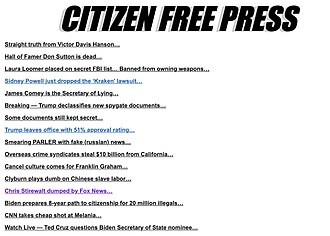
Citizen Free Press predominantly publishes short-form posts, headlines, aggregated links, screenshots, and brief commentary. Coverage tends to focus on conservative political angles, rapid reaction to breaking stories, and items that are likely to trend on social platforms.
The site often republishes excerpts or links to reporting from other outlets, sometimes with attention-grabbing framing alongside user-submitted or staff-curated items. Because the model is aggregation-first rather than long-form investigative reporting, the output is highly volume-driven and designed to keep readers constantly refreshing for updates.
The format is effective at driving repeat visits, and that dynamic appears to be the engine of its engagement statistics.
Business Model: How the Site Likely Makes Money
Like many high-traffic news aggregators, Citizen Free Press likely monetizes through display advertising, native ads, affiliate links, sponsored content, and possibly donation or subscription models for auxiliary projects. High pageviews and long sessions produce ad inventory value, which advertisers buy directly or through ad exchanges.
Third-party analytics suggest significant traffic volumes, which would translate into meaningful potential ad revenue if monetized efficiently. However, the site’s public pages do not provide a transparent revenue breakdown, which is common among privately held aggregator publishers.
Editorial Approach and Standards
The editorial style of Citizen Free Press leans toward rapid publication and amplification of viral items. This difference in editorial process explains why readers should treat some items on the site as starting points for further verification rather than definitive reportage.
Objective readers can use posts there as a heads-up, but they should cross-check claims with primary sources or established fact-checking organizations before accepting them as factual.
Political Orientation and Perceived Bias
Independent media-bias assessors have classified Citizen Free Press as ideologically tilted. Media Bias/Fact Check (MBFC) documents a conservative tilt and notes both the site’s unapologetic political alignment and the lack of disclosed ownership and funding.
Content analysis shows a pattern of story selection and headline framing that often favors conservative narratives and skepticism toward mainstream media or establishment political figures.
Readers who rely exclusively on a single source, particularly an ideologically aligned aggregator, are at risk of confirmation bias; savvy consumers will triangulate with a mix of outlets across the spectrum.
How the Site Differs From Traditional Newsrooms
Traditional newsrooms typically operate with staff reporters, named editors, editorial standards, corrections policies, and explicit sourcing. Citizen Free Press, being an aggregator, runs a thinner model: rapid curation, heavy reuse of third-party reporting, minimal original reporting, and a heavy emphasis on headlines and bite-sized posts.
This model can be useful for real-time awareness and trend spotting (it surfaces items quickly), but it has limits when it comes to original investigative work, nuanced context, and error correction. In other words, the site is designed to be fast and viral rather than slow and exhaustive.
Defenses and Supporters’ Arguments
Supporters and regular readers of Citizen Free Press make a few counterarguments. They note the site’s value as a rapid aggregator that surfaces stories mainstream outlets might underplay or ignore, thereby diversifying the pool of available information.
Some readers appreciate the site’s unapologetic political stance and find its curation useful for ideological confirmation and community building.
Others argue that the site functions like the Drudge Report or other long-standing aggregator models, offering a legitimate editorial niche: fast curation rather than original reporting. For many supporters, the primary metric of value is attention: the site keeps them informed of stories they care about in near-real time.
Fact-Checking and Reliability: Best Practices for Readers
Because Citizen Free Press often aggregates and amplifies viral items, readers should adopt a habit of verification: check the original reporting source linked in the post, look for corroboration from mainstream outlets or reputable local journalism, and consult independent fact-checking services like PolitiFact, FactCheck.org, or AP’s fact checks when claims seem extraordinary.
If an item is sourced to a screenshot of a social post, treat it as unverified until you find corroboration. Finally, be alert to emotionally loaded headlines; they are often designed to provoke immediate sharing rather than reflective consideration. Using these practices will help readers separate useful alerts from misleading claims.
The Platform’s Social Footprint and Amplification Dynamics
Citizen Free Press is closely integrated with social platforms—its posts are designed to be shared widely on Twitter/X, Facebook, and other networks. High engagement on social platforms helps the site’s items go viral, which in turn drives referral traffic back to the site.
This loop—post fast, get shares, traffic climbs—explains how the site scales its audience quickly and why it can be influential in shaping trending narratives. Because modern information cascades rely heavily on platform algorithms that reward engagement, a small number of viral posts can have an outsized impact on public conversation.
Comparisons: Where Citizen Free Press Sits Relative to Other Outlets
In terms of format and function, Citizen Free Press resembles other aggregation hubs like Drudge Report, The Drudge-style blogs, and several politically oriented aggregators. Compared with mainstream legacy outlets (e.g., The New York Times, AP, Washington Post), it offers less original reporting and more curated headlines.
Compared with partisan opinion outlets that produce long-form commentary (e.g., The Bulwark, National Review), it typically offers shorter, quicker posts rather than deep analysis. The key point: it is an aggregator-first site that excels at immediacy and trend surfacing, not at longform investigative journalism or rigorous, source-driven reporting.
Content Moderation, Comments, and Community Dynamics
Citizen Free Press often hosts a lively comment community and encourages sharing, which can create echo chamber effects. Some users and observers have complained about comment moderation practices, alleging the removal of dissenting viewpoints on certain platforms or strict moderation in comment threads. At the same time, supporters argue that moderation is necessary to keep conversations civil and to block abusive behavior.
Like most high-traffic sites, Citizen Free Press faces the dilemma of balancing open discussion with a desire to maintain a particular community tone and user experience. This dynamic affects how readers perceive the site’s reliability: if critical comments are removed, some readers infer bias or censorship, while others see moderation as necessary housekeeping.
Legal and Ethical Considerations
Legally, aggregation is permitted so long as copyright and trademark rules are respected, and many aggregators rely on linking and short excerpts under “fair use” principles. Ethically, though, the practice raises questions about attribution, revenue capture (i.e., drawing audiences away from original reporting), and responsibility for amplification.
Editors of aggregator sites must consider whether reposting sensational claims without adequate context could cause harm, especially during elections or fast-moving crises. The law provides some clarity; ethical norms demand more nuance. Readers and analysts scrutinize the site not only for what it posts but for how it frames and amplifies information that travels quickly across platforms.
Why People Use Citizen Free Press: Use Cases and Reader Profiles
Regular users fall into a few categories. First are politically engaged conservatives who want a fast feed of stories that reinforce skepticism toward mainstream outlets and highlight items that fit their worldview. Second are media professionals and amplifiers who monitor the site to detect viral narratives and breaking topics. Third are casual readers who stumble on sensational headlines through social shares.
Each group uses the site differently: some as a daily news shortcut, others as a trend-spotting tool, and some as entertainment. Understanding the user base clarifies why the site emphasizes speed and emotional framing: these features cater to an audience seeking affirmation, alerts, and social signal cues more than dispassionate reporting.
The Site’s Influence on the News Cycle
Due to its traffic scale and social media integration, Citizen Free Press can play a role in accelerating stories into the broader news cycle. When a post goes viral on the site and is rapidly shared on social media, mainstream outlets may pick up the story either to report on its significance or to correct misinformation.
Aggregator sites can therefore act as accelerants, sometimes surfacing neglected angles but other times amplifying unverified claims. That dual capacity spotlighting under-reported items while occasionally misfiring makes the site an important actor to watch for anyone tracking how narratives spread online.
Responsible Reading: A Practical Checklist
If you read Citizen Free Press (or similar aggregators), a short checklist will help you consume responsibly:
- Check the linked original story before sharing. If the post links to a social media screenshot, search for primary reporting.
- Look for corroboration from multiple independent outlets. Extraordinary claims require multiple sources.
- Consult fact-checkers for viral claims that seem dubious. Organizations like PolitiFact and FactCheck.org maintain searchable archives.
- Be cautious with emotionally charged headlines; pause to read the full text, not just the headline.
- Track corrections, good outlets issue clarifications; aggregator reposts may not update as diligently.
Applying this quick routine will reduce the chance of sharing errors and improve the quality of your information diet.
The Future of Sites Like Citizen Free Press
Aggregator models are resilient because they match how many people use the internet: quick scanning, social shares, and mobile consumption. At the same time, rising awareness of misinformation and platform enforcement actions could push aggregators toward greater transparency and improved sourcing.
Regulators and platforms are increasingly attentive to disinformation dynamics; advertisers and ad platforms are also sensitive to reputational risks. Depending on how policies and market incentives evolve, sites such as Citizen Free Press may either become more transparent and editorially accountable or continue to operate in the fast, opaque mode that created their audiences. The outcome will shape not only the site but also the broader online information environment.
Conclusion
Citizen Free Press is a powerful example of how modern attention economies shape news consumption. It fills a popular niche—fast, partisan curation that keeps a specific audience updated and engaged. That niche confers influence but also brings responsibilities that the format sometimes struggles to meet: deep sourcing, transparent ownership, and rigorous fact-checking.
For readers, the site can be a useful alert system and a way to surface stories that might be underreported, but it should not be the only source you rely on for factual certainty. Cross-checking, reading sources, and applying critical media literacy remain essential steps when navigating high-velocity aggregators. Ultimately, Citizen Free Press is neither uniquely evil nor uniquely virtuous: it is a consequential actor in the modern media landscape, one whose impact will depend on how readers, platforms, and regulators respond.
Frequently Asked Questions (FAQs)
1. Is Citizen Free Press a reliable news source?
Citizen Free Press is best understood as a high-speed aggregator rather than a traditional fact-checked newsroom. It reliably surfaces breaking and viral items quickly, but because many posts are short, sourced to screenshots, or framed provocatively, readers should verify important claims with original reporting or independent fact-checkers before treating them as definitive.
2. Who owns Citizen Free Press?
Public legal pages and terms point to operation under PATRIOT PRESS LLC, but the site has historically kept key details about funding and individual ownership opaque. Profiles and reporting have identified a pseudonymous editor figure often referred to as “Kane,” but complete transparency about ownership and backers is not publicly detailed on the site.
3. How big is the site’s audience?
Third-party web analytics firms estimate monthly traffic in the millions—often double-digit millions in recent reporting—making it one of the higher-trafficked politically oriented aggregators. These services provide useful estimates but are not the same as internal publisher analytics.
4. Does Citizen Free Press publish original reporting?
The site primarily aggregates and curates content rather than producing extensive original investigative reporting. You will find occasional commentaries or editorials, but the volume of original, long-form journalism is small compared with mainstream newsrooms.
5. Is Citizen Free Press partisan?
Yes—independent media-bias assessments classify its content as generally conservative in orientation, and its audience and editorial framing reflect a pro-conservative tilt. That partisan angle is explicit in story selection and headline framing.
6. Can I trust images and social screenshots posted there?
Treat social screenshots as unverified until corroborated. Screenshots are useful indicators but can be taken out of context or manipulated. Always follow a screenshot back to the source account or primary reporting for verification.
7. Does the site have a corrections policy?
The site’s public pages do not prominently display a comprehensive corrections policy like those found at major newsrooms; readers may need to check individual posts for updates or rely on external checks. The absence of a clear, easily accessible corrections page is a transparency weakness compared with legacy outlets.
8. Is Citizen Free Press blocked or banned anywhere?
As of the latest public information, the site is not broadly “banned,” though individual platforms may apply moderation policies to particular posts. Regulatory and platform moderation landscapes change frequently, so outcomes can vary by network and jurisdiction.
9. How should researchers cite or use stories from Citizen Free Press?
Researchers should use posts from the site only as leads and should cite the original primary sources rather than the aggregator when possible. If a researcher must cite the aggregator, they should indicate the post is a curated reproduction or excerpt of another source. Always prioritize primary source verification.
10. Will Citizen Free Press change its model soon?
Predicting editorial shifts is speculative. Market incentives favor speed and engagement, which supports the current model. However, changing platform rules, advertiser preferences, and public pressure could encourage greater transparency or editorial rigor over time. Watch for signs such as published funding disclosures, named editorial staff, or an editorial code of ethics.
Read More
SFlix – The Complete Guide to Free Streaming
Bovada LV – The Ultimate Guide
Carpet Beetle — A Complete Guide to Identification, Prevention, and Control
Birthday Freebies – The Ultimate Guide to Free Treats on Your Special Day






Leave a Reply